
TL;DR
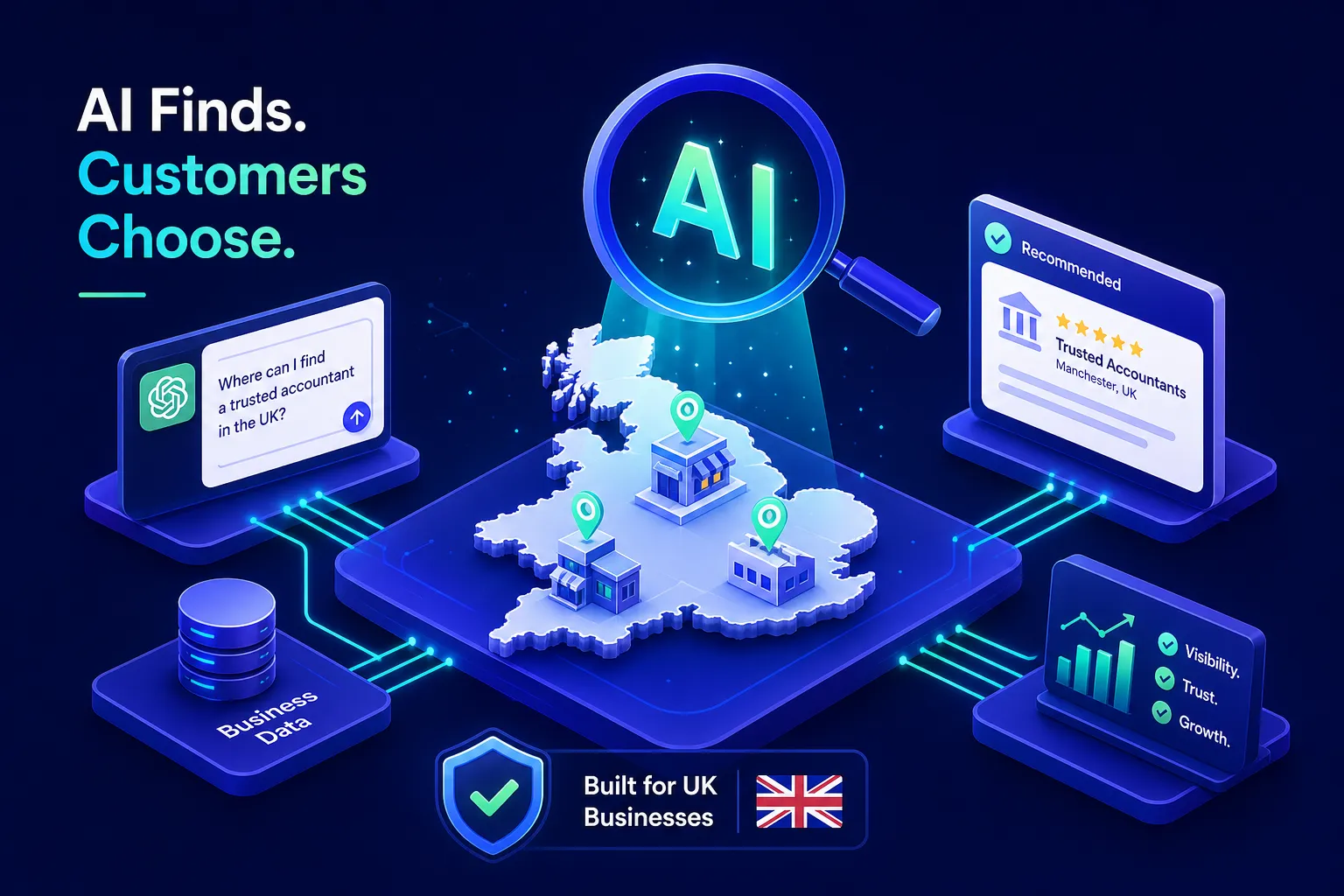
AI has changed how customers discover businesses. If ChatGPT, Google AI Overviews or Perplexity aren’t recommending your business, you’re invisible before a customer even visits your website. This article explains why that happens, how GEO (Generative Engine Optimisation) differs from traditional SEO, and how The GEO Agency helps UK businesses become the brands AI recommends.
Table of Contents
The Shift
Something has shifted in how buyers find businesses, and many SME owners are yet to notice. When a potential client opens ChatGPT and types “who’s the best financial adviser in Edinburgh?” or “which aesthetics clinic do you recommend in Manchester?”, the AI doesn’t serve up ten blue links. It names specific businesses with confidence, though the exact behaviour varies between platforms and query types. If your name isn’t in that answer, you’ve lost the enquiry before the buyer ever considered you.
This is the reality of search in 2026. AI assistants have become the first point of contact for a growing share of purchase decisions, and the businesses showing up in those answers aren’t there by accident. They’ve built the right signals, structured the right content, and earned the right third-party corroboration. Their competitors, most of whom are doing solid traditional SEO, remain invisible to every AI that matters.
The GEO Agency was built specifically to close that gap. Not as a traditional SEO shop with a GEO module added on, but as a full-stack AI visibility and GEO services agency designed from the ground up for how search actually works today. This article covers what the agency does, who benefits most, what results look like, and the questions you should ask before briefing any AI visibility specialist.
Why AI search has changed who gets found (and who gets ignored)
How AI assistants actually decide who to recommend
Tools like ChatGPT, Google AI Overviews, Perplexity, and Gemini don’t crawl the web fresh for every query. They synthesise answers from a vast ecosystem: third-party publications, review platforms, forums, structured data, and authority signals built up over time. The business on page one of Google is not automatically cited by AI. Citation requires a different kind of trust signal entirely, one built across the wider internet rather than concentrated on a single website.
Google AI Overviews, for example, features businesses whose content is credible, structured, and widely corroborated. The AI identifies and cites the sources it considers most authoritative for a given query. If your brand isn’t consistently described the same way across reviews, directories, publications, and your own site, the AI has no confident picture of who you are or what you do.
The gap between Google rankings and AI recommendations
Traditional SEO optimises a page so users click a link. Generative Engine Optimisation (GEO) shapes how AI synthesises your brand into its answer, often without a click ever occurring. That’s a fundamental shift in what search performance actually means. Your owned content may represent less than 10% of what AI systems weight when deciding whether to recommend you. The other 90% comes from third-party sources you don’t control, but can absolutely influence through a coherent AI search visibility strategy.
Many generalist agencies struggle to bridge this gap because their model is built around ranking pages and driving clicks. GEO requires a different discipline entirely, and that’s precisely why working with a specialist AI SEO agency makes a measurable difference.
Why The GEO Agency matters for UK SMEs
Most UK SMEs have invested in a website, perhaps some SEO, and a Google Business Profile. What they typically haven’t done is build the ecosystem of structured signals, third-party corroboration, and entity authority that generative AI systems rely on when forming recommendations. The GEO Agency exists to fix that, providing GEO services UK businesses can access without the complexity or cost structures designed for enterprise clients.
The approach covers everything from AI citation auditing to long-term authority building, with reporting tied to commercial outcomes rather than proxy metrics.
What The GEO Agency does: a plain-English service breakdown
GEO and AEO: getting your business into AI answers
Generative Engine Optimisation (GEO) and Answer Engine Optimisation (AEO) are distinct but complementary disciplines. GEO focuses on shaping how large language models understand and represent your business across their training data and retrieval layers. AEO targets specific question-and-answer formats so that when a user asks a direct question, AI tools surface your brand in the response.
In practice, this means building structured data, creating prompt-optimised content, establishing entity authority, reinforcing knowledge graph signals, and producing specialist navigation files, such as LLMs.txt, that guide AI models on how to interpret your expertise. These aren’t abstract tactics. One client in the design sector now receives over 1,500 monthly citations inside ChatGPT alone. Another saw a 447% increase in Google AI Overview mentions within six months. The mechanism is consistent: build the signals AI systems trust, and AI systems start recommending you.
SEO and reputation management: the full-stack foundation
Traditional SEO isn’t legacy. It still drives significant traffic and feeds the authority signals that AI systems draw from. Technical SEO, link authority, and content quality remain the bedrock. What’s changed is that reputation management, once considered a local SEO tactic, is now a primary input into what AI assistants decide to trust. Review velocity, citation consistency, NAP data accuracy, and third-party corroboration all feed directly into AI recommendation logic.
The GEO Agency treats these as an integrated system. Technical SEO, digital PR, review strategy, and citation building are managed in concert rather than in silos. You don’t achieve AI search visibility without the foundation, and the foundation alone won’t get you recommended by AI. Both layers have to function together.
AI automation and advisory: for teams that need more than execution
Beyond the core optimisation work, the agency offers bespoke AI automation builds for content creation, reporting, and outreach, alongside strategic workshops and AI Visibility Audits. These options serve founders and marketing leads who want to understand the AI search landscape before committing to full-scale optimisation. The AI Visibility Audit is the natural entry point: a scored diagnostic report showing how major AI tools currently perceive your business, where citations are missing, which competitors are being recommended instead, and what the specific barriers to AI recommendation are. No credible agency should promise results before understanding the current state.
The experience behind the strategy
How The GEO Agency approaches AI visibility strategy
The GEO Agency was founded by a strategist whose background spans enterprise digital transformation work with household-name clients including Virgin Media, O2, Samsung, LEGO, RBS/NatWest, and ITN. That experience shapes how the agency approaches every client engagement. Generative AI search optimisation isn’t treated as an experiment or a trend to capitalise on. It’s approached with the same strategic rigour used to shape digital strategy for global brands, applied at a scale and price point that works for businesses with 10 to 200 employees.
The practical difference this makes is straightforward. SMEs working with The GEO Agency get access to strategic depth that was previously only realistic for organisations with six-figure agency budgets. The thinking is enterprise-grade; the engagement model is built for SME realities. For a growing business at the £50k, £500k turnover stage, that typically means a structured audit, a prioritised roadmap, and measurable citation targets from day one, without the overhead of a retainer designed for a FTSE 100 brand.
Why plain-English communication is a strategic advantage
Most digital agencies communicate in acronyms and dashboards that tell you almost nothing about what’s actually happening with your investment. The GEO Agency is built on translating complex AI search behaviour into clear commercial decisions. Reporting is structured around business outcomes: brand mention frequency in AI responses, share of voice against named competitors, AI referral traffic from ChatGPT and Perplexity, and AI prominence, whether your brand appears early or buried in a response. These are the metrics that tell you whether the work is paying off, not vanity figures that look impressive but don’t connect to revenue.
The businesses that benefit most from AI visibility investment
Industries where AI recommendations move the needle hardest
Medical aesthetics and beauty clinics are among the highest-impact sectors. Patients now ask AI assistants for trusted practitioners before ever opening a browser tab. If your clinic isn’t being recommended, a competitor is. Financial advisers and wealth managers face the same dynamic: clients research credibility through AI tools before making first contact, and trust signals are everything in that process. Independent estate agents need hyper-local AI recommendations to compete against national brands for buyers and sellers asking “who’s the best agent in [area]?”. Hotels and hospitality brands need AI assistants to name them directly rather than defaulting to aggregator platforms.
Growth-stage SMEs with in-house marketing teams are also a natural fit. They understand that GEO matters; they simply lack the bandwidth or specialist knowledge to act on it. Closing that gap is precisely what the agency is built to do.
What makes an SME ready to invest in GEO services
A business benefits most from GEO when it already has a functioning digital presence: an active website, a claimed Google Business Profile, and at least some existing reviews. The AI Visibility Audit confirms readiness, identifies the fastest wins, and sets a realistic improvement timeline before any retainer begins. Businesses seeing the strongest returns are those with a clear proposition that AI assistants can learn to represent accurately, supported by the review volume and third-party presence that signals genuine authority.
How to evaluate any GEO agency before you commit
Questions worth asking any AI visibility specialist
Start by asking whether the agency was built for GEO from the outset or retrofitted it onto existing SEO services. The distinction matters enormously in practice. Then ask for prompt testing examples: can they show you, live, how AI tools currently answer queries relevant to your business, and what their specific plan is to change those answers? Ask what they track: a credible agency reports on AI citation rate and share of voice, not just organic traffic. Ask about contract terms: serious GEO specialists offer 90-day sprint models or short-commitment retainers rather than locking SMEs into 12-month agreements with little accountability.
If an agency can’t explain how they’ll measure your brand’s citation frequency in AI responses, or if they pivot back to keyword rankings as their primary metric, they’re unlikely to be operating in the GEO space with any real depth.
How The GEO Agency measures AI citations
Measurement is where many agencies fall short on GEO. The GEO Agency tracks brand mention frequency across named AI platforms, share of voice relative to competitors, and AI referral traffic, the sessions that arrive via tools like ChatGPT and Perplexity rather than through a search engine results page. Prompt testing is conducted at the start and throughout the engagement, giving clients a concrete before-and-after view of how AI tools describe their business. This approach to GEO agency comparison makes it straightforward to assess whether the work is actually moving the needle.
Typical costs and what the investment covers
UK GEO pricing spans a wide range, from entry-level programmes at a few hundred pounds a month to £20,000 and above for national brands, and the right figure depends entirely on scope. Judge any quote on what it actually includes rather than on a minimum price: which engines are queried, how often the work is measured, whether you receive the verbatim AI answers as evidence, and who reviews the findings before they reach you.
GEO agencies typically price 40 to 60% higher than traditional SEO agencies, and that premium is justified by the specialist knowledge required. Research from 2026 tracking AI-driven commercial activity puts the value of B2B AI citations at over £4,000 per 100 mentions, reflecting a USD-to-GBP conversion of the underlying dataset.
The GEO Agency’s model is transparent and outcome-led, structured around what SMEs can realistically invest with a clear picture of what the return looks like. The 90-day results commitment exists because accountability should be built into the engagement from day one, not buried in a 12-month contract clause.
For context on how GEO compares with more familiar SEO approaches and agency models, see a practical discussion of GEO vs traditional SEO, which highlights the different inputs and outcomes you should expect when choosing a specialist over a generalist provider.
FAQ
What is Generative Engine Optimisation (GEO)?
Generative Engine Optimisation (GEO) is the process of improving how AI platforms like ChatGPT, Google AI Overviews, Gemini and Perplexity understand and recommend your business. Unlike traditional SEO, GEO focuses on becoming part of the AI’s answer rather than simply ranking a webpage.
Is GEO replacing SEO?
No. SEO and GEO work together. Traditional SEO still provides the technical foundation and authority signals, while GEO builds the additional trust, entity and citation signals that AI systems use when deciding which businesses to recommend.
Why isn’t my business showing up in ChatGPT?
AI doesn’t simply copy Google’s search results. It evaluates information from your website alongside reviews, directories, trusted publications, structured data and other third-party sources. If those signals are weak or inconsistent, your business is less likely to be recommended.
How long does it take to improve AI visibility?
Every business is different, but many improvements can be seen within the first 90 days when the right authority, citation and content signals are implemented. Long-term authority building continues beyond that as your digital footprint grows.
What is an AI Visibility Audit?
An AI Visibility Audit is a detailed assessment of how AI platforms currently perceive your business. It identifies where you’re being mentioned, which competitors are recommended instead, where citation gaps exist and what should be prioritised first.
How do you measure AI visibility?
Rather than focusing solely on keyword rankings, AI visibility is measured using metrics such as AI citations, share of voice, brand mentions across AI platforms, AI referral traffic and prompt testing against competitors.
Can I do GEO myself?
Some improvements can be made in-house, but effective GEO requires an understanding of entity optimisation, structured data, AI citation signals, digital PR, reputation management and how large language models interpret brands. Most businesses benefit from specialist guidance to avoid wasting time on tactics that don’t move the needle.
Is GEO only for large companies?
There isn’t a one-size-fits-all answer. Many specialist GEO agencies charge thousands of pounds per month, often with long-term contracts.
At The GEO Agency, we’ve built a different model for SMEs.
Our AI visibility software, Aurora, starts free, with the full plan at £247 a month. When you want us to do the work, we scope it to your business, and it can include:
Generative Engine Optimisation (GEO)
Traditional SEO (on-page and off-page)
AI-optimised content creation
Ongoing AI visibility improvements
A human quality-control layer to ensure every recommendation is accurate, commercially relevant and aligned with your brand
We believe AI should enhance expert strategy, not replace it. That’s why every piece of work is reviewed by a human before it’s delivered, giving you the speed of AI with the quality and judgement of an experienced consultant.
The logical first step
AI search is not coming. It’s already here, reshaping how buyers across the UK discover and vet businesses. Many SMEs are currently invisible to AI assistants, not because their business isn’t good enough, but because the signals AI systems rely on haven’t been built or maintained. It’s a fixable problem, and building those signals is exactly what The GEO Agency was designed to do.
The starting point is an AI Visibility Audit: a clear-eyed diagnostic showing where your business currently stands in AI search, which competitors are being recommended in your place, and what a realistic improvement timeline looks like. It’s the honest foundation every engagement begins with, because understanding the current state is the only way to set meaningful targets and hold the work to account.
If you’re ready to find out where your business stands, book your AI Visibility Audit with The GEO Agency or get in touch to talk through your specific situation. The initial conversation is complimentary, and the diagnostic insight is delivered promptly, so you leave with a clearer picture of your AI search visibility, whatever you decide to do next.

AI Visibility Expert and Founder of The GEO Agency, helping travel, hospitality and property companies win visibility in AI search. 28 years of digital marketing, brand strategy and enterprise digital transformation experience with brands including Virgin Media, O2, Samsung, LEGO, RBS/NatWest and ITN. Author of the ChatGPT Blueprint, Anthropic Claude Partner Network member and Claude Certified Architect.


